Imagine a keyboard with nothing but white keys:
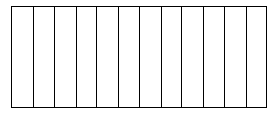
It would be very difficult to keep track of which note was which. Early keyboards were a bit like this until someone had the idea of painting some of the keys black:

Then an even brighter and better idea - the black keys were narrowed and raised in height so that the player could find individual keys by touch alone:
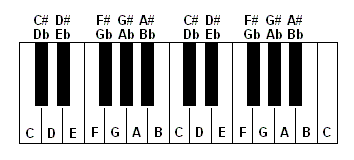
The clever part of all this is the pattern of black notes grouped as they are in twos and threes, enabling the player uniquely to identify each note on the keyboard.
Understanding the Chromatic scale (continued)
The white (natural) notes are defined as follows:
C positioned just
to the left of the group of two black notes
D positioned between the two black notes
E positioned just to the right of the group of two black notes
F positioned just to the left of the group of three black notes
G positioned between the first two out of the group of three black notes
A positioned between the second two out of the group of three black notes
B positioned just to the right of the group of three black notes
The black notes each have two possible names depending on whether you are looking up at them from the note below or down at them from the note above.
C# is just to
the right of C and can also be called Db because it's just to the left
of D
D# is just to the right of D and can also be called Eb because it's just
to the left of E
F# is just to the right of F and can also be called Gb because it's just
to the left of G
G# is just to the right of G and can also be called Ab because it's just
to the left of A
A# is just to the right of A and can also be called Bb because it's just
to the left of B
But notice that there is no E#, Fb, B# nor Cb because we have to leave a gap in the pattern of black notes at these points or the poor keyboard player would be right back where we started.
The chromatic scale is best learned in both directions:
Ascending using
sharp (#) names: C C# D D# E F F# G G# A A# B C and
Descending using flat (b) names: C B Bb A Ab G Gb F E Eb D Db C
The guitar fretboard is arranged chromatically and knowing this scale is the key to working out all the notes on your guitar. For example, here are the notes on the E string:
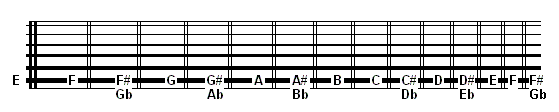
See if you can apply this scale to figure out the notes on the other strings.